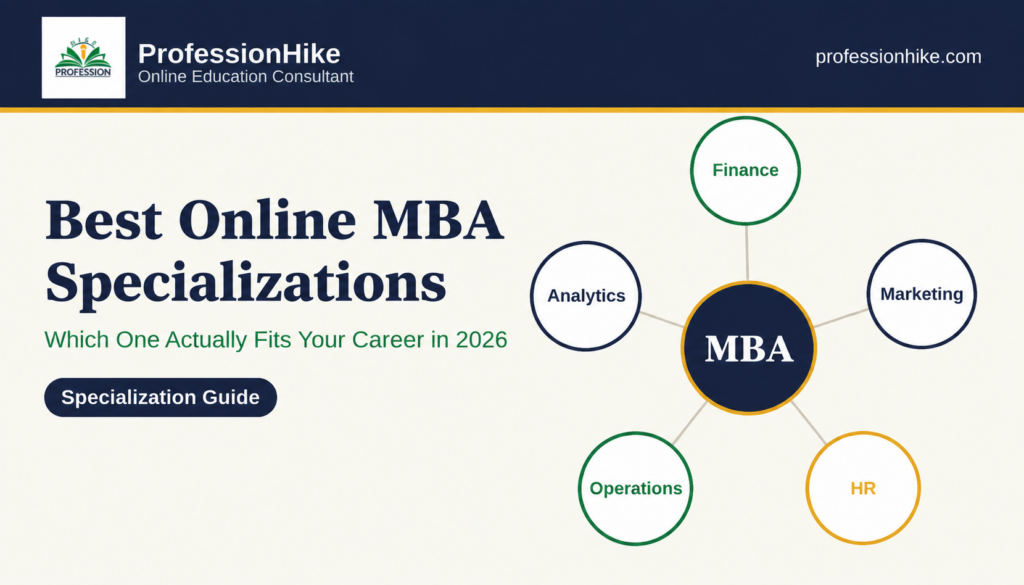
A practical specialization breakdown for students and working professionals comparing Online MBA options in India.
Most of the conversation when someone's planning an online MBA goes toward the university. Which one has the better name, which one's cheaper, which one's accredited properly. The specialization gets decided almost as an afterthought, sometimes in the last ten minutes of an admissions call. That's a strange order of priorities when you think about it, because the university opens a door, sure, but the specialization is what you're actually doing for the next couple of years, and often for a good chunk of your career after that.
So here's the specialization breakdown, without the usual "each one is great in its own way" hedge. Some genuinely suit certain people more than others.
Why This Choice Deserves More Than Ten Minutes
Two people can graduate from the same college, same batch, same MBA tag on LinkedIn, and end up on completely different tracks purely because of what they specialized in and how they used it afterward. A Finance specialization tells a banking recruiter something specific. Business Analytics tells a very different story to someone building out a data team. Pick one because your friend picked it, or because an article somewhere called it "trending," and you'll probably end up with a degree that doesn't clearly point anywhere.
Finance
Still one of the most structured, recognizable specializations out there. Corporate finance, investment analysis, risk management, that sort of thing. It works well if you're eyeing banking, equity research, corporate finance teams, or financial consulting, and it stacks nicely with something like CFA or FRM afterward if you want to keep building in that direction.
Marketing
Probably the broadest option here. Brand strategy, consumer behavior, digital marketing, and now increasingly marketing analytics gets folded in too. That breadth cuts both ways, honestly. It opens doors in almost every industry, but it also doesn't carry the same "depth signal" that something like Finance or Analytics does on a resume.
Makes the most sense for people already in brand or product marketing roles looking to move up into something more strategic.
Human Resources
Organizational behavior, talent management, compensation strategy, labor law. This one's fairly specific in who it suits, mostly people already working in HR who want to move from an operational role into HRBP or people-strategy leadership. Not a common pick for someone with zero HR background, and honestly, it probably shouldn't be, given how narrow the career path it supports actually is.
Operations and Supply Chain Management
This has quietly become a lot more relevant over the past few years as manufacturing, logistics, and e-commerce in India have all scaled up. Supply chain design, logistics management, process optimization. If you're already in manufacturing, retail operations, or fulfillment, this is a natural next step rather than a leap.
Business Analytics and Data-Driven Management
The fastest-growing pick right now, and it's not hard to see why. Nearly every function, marketing, operations, finance, runs on data to some degree now, and people who can sit between business strategy and data literacy are genuinely scarce. Coursework usually covers data-driven decision-making and analytics tools, with a growing amount of applied AI content creeping in too.
This one's less about your existing background and more about where you want your MBA to intersect with, well, wherever most industries are actually headed.
A Decent Way to Decide, If You're Stuck
Work backward from the job you actually want two or three years out. Not the specialization name that sounds best at a dinner party, the actual job. Then ask three things: what does that role's job posting usually ask for, what do the people already in that role have on their resumes, and does the specialization give you something concrete to talk about in an interview, or just a line on a transcript nobody reads closely.
If all three point the same direction, go with it, even if it's the less flashy option.
Specializations Aren't Equal Across Universities
Worth checking this properly instead of assuming every university teaches every specialization with the same depth, because they don't. NMIMS Online has a noticeably strong Finance and Analytics track, from what we've seen. Amity Online tends to offer one of the wider specialization catalogs overall, which helps if you're still not 100% sure which direction to commit to. Either way, it's worth comparing specialization depth across online universities before locking anything in. Brand name matters less here than how seriously a university actually treats your specific track.
Explore university and course information before deciding which specialization fits your career direction.
Can You Mix Specializations?
Some universities now run dual-specialization or elective-heavy structures, usually pairing Analytics in as a secondary track alongside Finance, Marketing, or Operations. Worth asking directly if that's something you want. It can give you a slightly wider skill set without watering down your main direction too much, though it does mean more coursework to juggle.
Frequently Asked Questions
Which specialization pays the most?
Can I switch specializations partway through?
Do I need a technical background for Business Analytics?
Does the specialization name actually matter to employers, or is it just a label?
Not Sure Which Online MBA Specialization Fits You?
Not sure which specialization actually fits where you're headed? ProfessionHike offers free counselling to help you match your online MBA specialization to your real career direction, not whatever's trending this year.
Get Free Expert Counselling →Read More from ProfessionHike
Continue your Online MBA & university researchOnline MBA vs Regular MBA: Which Makes More Sense for Working Professionals?
Explore the key considerations when comparing online and regular MBA formats.
Explore ProfessionHike →Online Colleges in India: What Actually Separates a Good One From a Mediocre One
Understand the factors worth checking when evaluating online universities and programs.
Read Article →NMIMS Online: A Complete Guide to Courses, MBA Programs, and Admission
Explore NMIMS Online information, MBA programs and admission-related considerations.
Read Article →