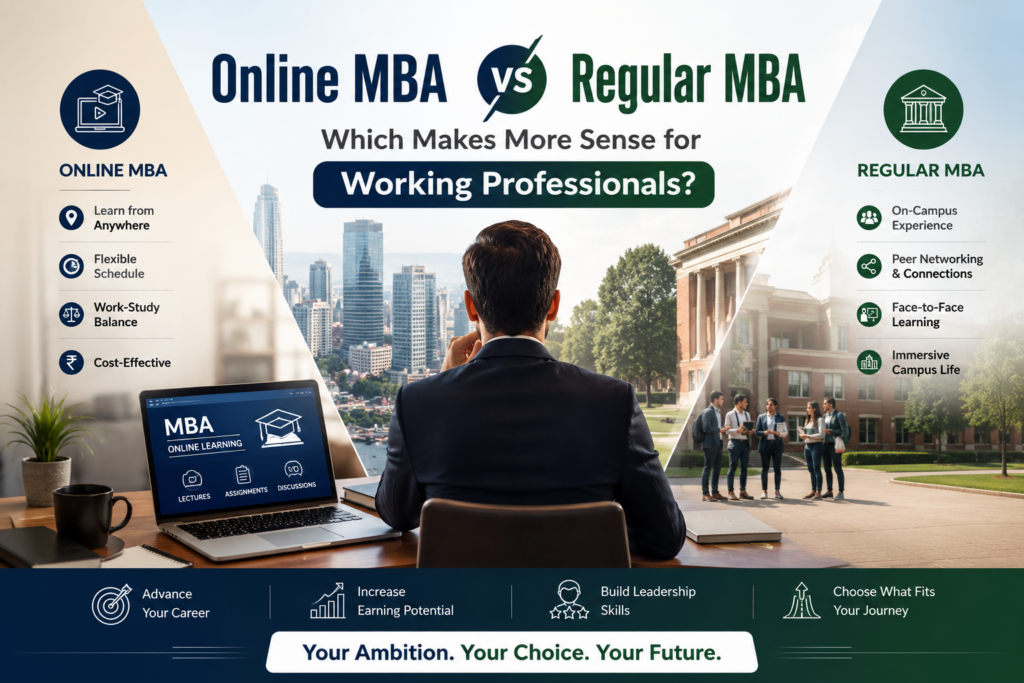
The honest starting point for this comparison is that a regular, full-time MBA and an Online MBA aren't really competing for the same student. Someone who can realistically take two years off work, relocate if needed, and absorb a higher cost for the campus experience is asking a different question than someone who has three years of work experience, a mortgage or rent to keep paying, and no intention of pressing pause on their career. This article is written for the second person.
What You're Actually Giving Up With a Regular MBA
A full-time, on-campus MBA does offer things an Online Program genuinely can't replicate: dense peer networking, campus placement drives, and an immersive environment that some people learn better in. For a 22-year-old two years out of undergrad with limited work experience, that trade-off often makes sense, since the opportunity cost of two years is lower and the campus placement pipeline can meaningfully jumpstart a career that hasn't started yet.
For someone already three, five, or ten years into a career, that same trade-off looks different. Two years without income, plus tuition, plus the risk of restarting professional momentum from a lower rung, is a much steeper cost. The campus placement pipeline also matters less to someone who already has an established professional network and isn't starting from zero.
What an Online MBA Actually Offers a Working Professional
The core value proposition is straightforward: you keep your salary, keep your seniority and momentum at your current company, and add a postgraduate qualification without the two-year income gap. For a lot of employers, that combination of continued relevant experience plus a recognised MBA reads as more valuable than the degree alone would, since it demonstrates you managed both simultaneously rather than needing to step away to get it.
The trade-off, and it's a real one, is a less immersive peer environment and typically no dedicated campus placement drive. This matters less if your goal is advancement within your current field or company, and matters more if your actual goal is a career pivot into an entirely new industry, where a placement pipeline and cohort-building would have carried more weight.
The Question That Actually Decides This, Not "Which Is Better
"Rather than asking which format is objectively superior, a more useful question is what you're actually trying to get out of the MBA. If the goal is a promotion or lateral move within your existing industry, an online MBA with a specialisation aligned to that industry generally serves the purpose well, and the continued work experience during the program often counts in your favour. If the goal is a hard pivot into a new field entirely, say, moving from engineering into consulting the networking and placement infrastructure of a full-time program carries more practical weight, and the two-year pause becomes a more justifiable cost against that specific goal.
Being honest about which of these two situations you're actually in does more to answer this question than any general comparison of formats.
Does an Online MBA Get Treated Differently by Employers?
Less than it used to, and the gap keeps narrowing. A UGC-DEB approved online MBA from a university with a genuine academic track record is increasingly evaluated on the specialisation and the university's reputation, rather than being discounted simply for being delivered online. That said, the university and course-specific approval still matter enormously here: an online MBA from a properly accredited, well-regarded university and one from a barely-compliant program marketed aggressively online are not treated the same way, even though both technically fall under "online MBA."
This is worth remembering before assuming the format itself, rather than the specific program's quality, is what determines how an employer reads the degree.
Cost Comparison: Not as One-Sided as It Looks
A regular MBA's total cost isn't just tuition; it includes two years of foregone salary, which for most working professionals dwarfs the actual tuition difference between formats. An online MBA's total cost is generally lower on tuition alone, and the absence of an income gap means the effective cost, accounting for lost earnings, is dramatically lower for someone already employed. This calculation shifts considerably depending on your current salary and how many years of experience you already have, but for most professionals past the first couple of years in the workforce, the math tends to favour the online path once foregone income is actually factored in.
Making the Actual Decision
If you're weighing this as a working professional rather than a fresh graduate, the honest framework is: a regular MBA makes more sense if you're pursuing a significant career pivot that genuinely benefits from campus placements and immersive networking, and can absorb the income gap. An online MBA makes more sense if your goal is advancement within a field you're already in, and continuing to earn and build experience alongside the degree serves your actual goal better than pausing would.
If you're leaning toward the online path and want to compare specific universities and specialisations rather than deciding in the abstract, Profession Hike offers free counselling to walk through Online MBA options and current fee structures based on your specific career stage and goals, rather than a generic comparison that doesn't account for where you actually are right now.
Frequently Asked QuestionsIs
An online MBA respected as much as a regular MBA by employers in India?
For a UGC-DEB approved online MBA from a university with genuine academic credibility, the gap in perception has narrowed considerably. Employers increasingly evaluate the specialisation and university reputation rather than discounting the degree simply because it was delivered online.
Can I do an online MBA while working full-time without affecting my job? Yes, for most working professionals, since online MBA programs are structured around evening and weekend availability specifically to accommodate a full-time job. The workload is real and does require consistent time management, but it's designed not to require stepping away from work.
Is a regular MBA worth the two-year income gap compared to an online MBA?
It depends on your goal. If you're pursuing a significant career pivot into a new industry where campus placements and immersive networking genuinely matter, the income gap can be worth it. If your goal is advancement within your current field, the online path often makes more financial and practical sense.
Does an online MBA cost less than a regular MBA overall?
Ttuition alone is often somewhat lower for online programs, but the bigger cost difference comes from the two years of foregone salary in a regular MBA, which usually outweighs the tuition gap by a significant margin for someone already employed.
Which specialisation matters more for an online MBA aimed at career advancement?
A specialisation aligned with your current industry or the direction you want to move in typically matters more than the university's overall brand name. An MBA in Finance from a well-regarded university means less for a marketing career pivot than a Marketing specialisation would.
Do recruiters ask which mode of MBA a candidate completed?
Occasionally, particularly for senior or specialised roles, but it's increasingly treated as one data point among several rather than a deciding factor, especially when the degree comes from a properly UGC-DEB approved program with a credible university behind it.
Online MBA vs Regular MBA: Which Makes More Sense for Working Professionals?